
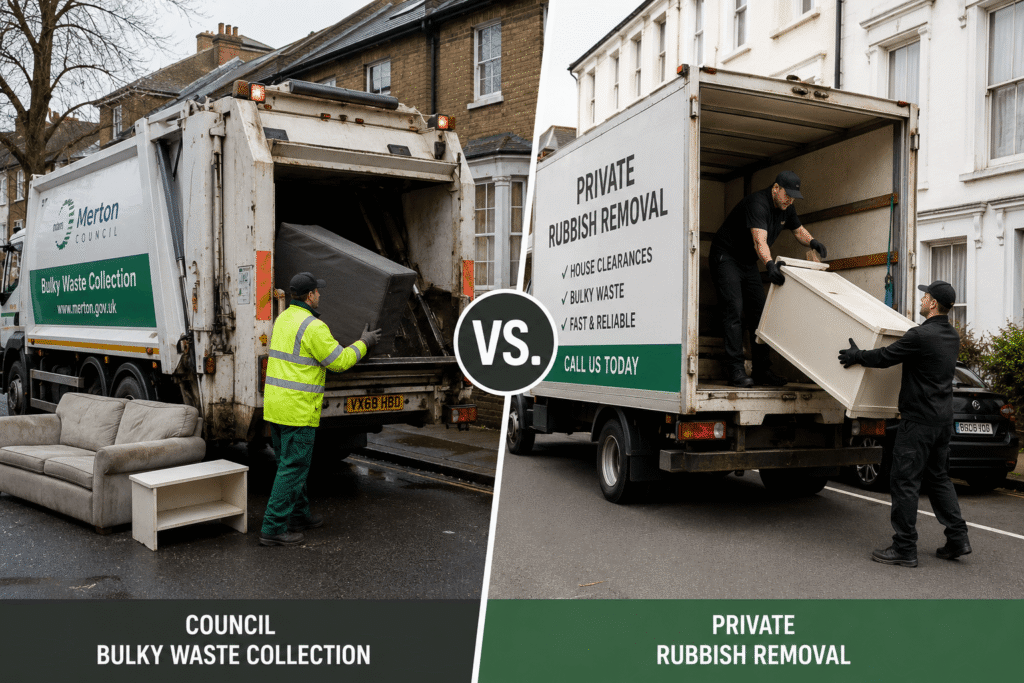
Council Bulky Waste Collection vs. Private Rubbish Removal in London: Which Should You Choose?
When you need to get rid of unwanted items in London, you usually have two options: book a council bulky waste collection, or use a private rubbish removal company. Both can do the job, but they’re built for different situations.
The right choice depends on a few things: the type of waste, how quickly you need it gone, whether you need help lifting and carrying, and how much you actually have to clear. This guide breaks down the differences so London residents, landlords and businesses can pick the option that actually fits their situation.
What is council bulky waste collection?
Council bulky waste collection is designed for household items too large for your normal bins — think furniture, mattresses, appliances, and other big domestic items. Every council sets its own rules, prices, waiting times and item limits, so it’s worth checking your local authority’s website before booking.
In most cases, you’ll need to leave items outside the property on the agreed collection day. The crew typically won’t enter your home, carry things down from upstairs, dismantle furniture, or take loose/mixed rubbish from inside. Many councils also cap the number of items per booking.
This works well if you’ve got one or two items, you’re not in a rush, and you can safely get them outside yourself — an old chair or a small table, for example.
It’s worth knowing that bulky waste sits outside the government’s Simpler Recycling rules, which came into force across England on 31 March 2026 and standardised everyday food waste and dry recycling collections in every borough. That reform doesn’t touch furniture, mattresses or appliances — those still need a separate, paid booking, and the wait is typically 5–14 working days. Pricing also varies far more than most people expect: the City of London charges £42.50 for up to three items, the Royal Borough of Greenwich charges a flat £13.82 per item, and Barking & Dagenham is currently running a pilot scheme offering up to four items completely free. There’s no single London-wide rate, so it’s worth checking your own council’s page rather than assuming a flat fee.
What is private rubbish removal?
Private rubbish removal is a more flexible, hands-on service. A team turns up with a van, loads the waste themselves — including carrying it out of the property where needed — and takes it away for proper disposal. It covers a much wider range of waste than council collections: furniture, bagged rubbish, garden waste, renovation debris, office clearouts, loft and garage contents, appliances, and general household clutter.
The main appeal is convenience. You don’t have to move everything outside yourself — the team can load directly from a house, flat, garden, office, storage unit or commercial unit.
Private rubbish removal is especially useful when the job involves:
- Urgent or same-day collection
- Large or mixed loads
- Heavy items
- Stairs or awkward access
- A full or partial property clearance
- End-of-tenancy rubbish
- Renovation waste
- Garden or shed clearance
- Office or commercial waste
There are very few restrictions on what these companies will take.
Speed and availability
This is one of the biggest differences. Council collections often involve waiting for an available slot — fine if you’re not in a hurry, but awkward if you’re moving house, prepping a rental property, finishing a renovation, or working to a deadline.
Private companies tend to offer much quicker turnaround, sometimes same-day or next-day depending on your area. That makes them a better fit for landlords, estate agents, builders, shop owners, and anyone who can’t afford to leave rubbish sitting around.
In London specifically, speed matters because outdoor space is limited. Plenty of homes have no front garden or driveway, and nowhere safe to leave bulky items while they wait for collection. Leaving rubbish out on the pavement without a confirmed pickup can quickly cause problems with neighbours, the council, or street access.
Labour and lifting
Council collections are generally collection-only — you bring the items outside, they take them away. That’s a real obstacle if something is heavy, you live in a flat with no lift, or furniture needs to be taken apart first.
Private removal almost always includes labour. The team can clear rooms, carry items down stairs, and load the van themselves. For a lot of customers, this is the deciding factor — especially if there’s no one around to help with heavy lifting.
Think: a sofa coming out of a second-floor flat, bags coming down from a loft, a wardrobe that needs dismantling, or garden waste from the back of a property. All of this is far easier with a private team doing the lifting.
Cost comparison
Council collection can look cheaper on paper, particularly for a small number of items you can move yourself. But for bigger or messier jobs, that price advantage shrinks fast — multiple bookings, mixed waste, or anything requiring lifting help adds real time and effort, even if the up-front fee is lower.
Private removal typically costs more than a basic council booking, but the price usually bundles in labour, loading, transport and disposal. For larger jobs, that often works out better value than arranging several separate council collections — or hiring a skip.
To put real numbers on it: man-and-van removal in London generally scales with how much space your rubbish takes up in the van — roughly £90–£130 for a small, quarter-van load, rising to £250–£300 or more for a full van, based on current London pricing guides. That’s typically all-in, covering labour, loading and disposal.
Skip hire can look like the budget option, but it often isn’t once you add everything up. A skip itself usually costs somewhere between £175 and £360, and if it needs to sit on a public road or pavement, you’ll also need a council skip permit — averaging around £68 in London but ranging from roughly £30 to £165 depending on the borough — plus a daily parking bay suspension fee if the spot is in a controlled parking zone. A handful of boroughs, including the City of London, don’t allow skips on the public highway at all. None of that applies to a man-and-van booking: there’s no permit to arrange, and everything gets cleared in one visit.
What about responsible disposal?
Whichever route you take, responsible disposal matters. Make sure your waste is being collected by an authorised operator. With a private company, it’s reasonable to ask whether they’re registered to carry waste and whether they can show proof if asked.
This isn’t just good practice — it’s a legal requirement. Under the Environmental Protection Act 1990, householders have a specific duty to take reasonable steps to ensure their waste only goes to an authorised carrier. In practice, that means checking the company’s waste carrier registration on the Environment Agency’s public register, which takes well under two minutes online — registration numbers issued in England start with the prefix “CBDU.” It’s also worth noting down the registration plate of the collection vehicle, asking for an invoice, and being wary of anyone who’ll only take cash.
This matters more in London than almost anywhere else in England. The most recent Defra figures show local authorities across England dealt with 1.26 million fly-tipping incidents in 2024/25, up 9% on the year before, and London has the highest rate of any region — 53 incidents per 1,000 people, against a national average of 21. Household waste makes up the large majority of cases, and single-item fly-tipping such as furniture and mattresses rose 12% year on year. If fly-tipped waste is traced back to you, you can face a fine; at the more serious end, fly-tipping itself carries an unlimited fine and up to two years in prison. Unregistered collectors can undercut on price precisely because they’re cutting this corner — a reputable company won’t be offended if you ask about registration, where the waste goes, or for paperwork. These are normal, sensible questions.
Quick comparison
| Council collection | Private removal | |
|---|---|---|
| Best for | A few simple items | Large, mixed or urgent jobs |
| Speed | 5–14 working days | Often same/next-day |
| Typical cost | Roughly £0–£60 per booking, varies by borough | Roughly £90–£300+, scales with load size |
| Labour | You move items outside | Team loads and carries |
| Access | Outside the property only | Inside the property, including upstairs |
When council collection makes sense
- You only have a few items
- You’re not in a hurry
- You can move everything outside yourself
- The items meet your council’s rules and limits
- You don’t need any lifting help
- You’re comfortable waiting for a booking slot
When private removal makes sense
- You need fast collection
- The rubbish is inside the property
- There are stairs or difficult access
- You’ve got mixed waste
- You need a full or partial clearance
- The job involves heavy lifting
- You need flexible timing
- You want it gone now, not in a week or two
For comparing private operators in London, companies such as Snappy Rubbish Removals and Express Waste Removals are among the names people turn to when they need fast removal rather than a basic council booking.
Final thoughts
There’s no single right answer — it depends on your situation. Council bulky waste collection is a solid fit for small, planned jobs where you’re not pressed for time. Private rubbish removal wins on speed, convenience, labour and anything large or complicated.
With Simpler Recycling now standardising everyday bin collections across every London borough, bulky waste is one of the few areas where councils and private companies still genuinely compete on different terms — speed, access, labour and price all pull in different directions depending on the job. If it’s simple and you can wait, the council option is probably enough. If it’s urgent, heavy, mixed, or sitting inside the property, a professional private removal service is usually the more practical call.